 USD
USD EUR
EUR
 AUD
AUD
 GBP
GBP
 INR
INR



I think this is a question that has come to almost every Labradorite lover’s mind at least once: Why does Labradorite look different from every angle?
Sometimes you see a beautiful blue flash, then you move the gemstone slightly and suddenly it looks golden, green, purple, or almost completely different. So, what makes Labradorite so mysterious?
Let me tell you about a real experience with one of our clients, Sonam.
Sonam wanted a gemstone that she could wear for protection, so we suggested a beautiful Labradorite pendant to her. She was very excited to see it because Labradorite is one of those gemstones that can look completely different in person compared to photographs.
When she saw the pendant, the first thing she noticed was its beautiful flash.
She told us, “This gemstone is so beautiful. I really love the flash!”
She took the pendant home and followed her usual cleaning and activation process before wearing it. But when she was getting ready to wear it, she noticed something interesting.
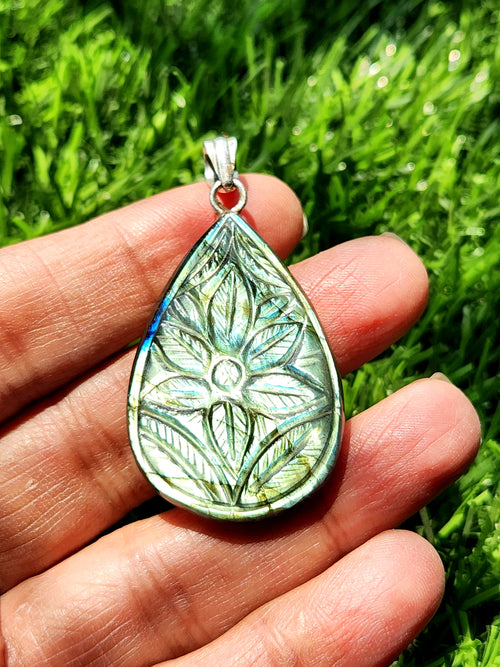
The pendant was shining differently again…..
The flash she had noticed when she first saw the pendant was not looking exactly the same now. The colour and intensity appeared to have changed.
That evening, she called me and asked, “Why does my Labradorite look different now?”
And this is where the fascinating science of Labradorite begins.
Why Does Labradorite Change Colour?
First of all, Labradorite does not actually change its basic colour every time you move it. What changes is the way light interacts with the internal structure of the gemstone.
The beautiful flashes seen in Labradorite are commonly known as labradorescence.
Labradorescence is an optical effect that happens because of the internal structure of Labradorite. The stone contains extremely thin layers within its feldspar crystal structure. When light enters the gemstone, it interacts with these microscopic layers.
Some of the light is reflected from different internal surfaces. These reflected light waves can interact with one another, producing the spectacular flashes of colour that Labradorite is famous for.
This is why one small movement of the pendant can make such a big difference.
Why Does Labradorite Look Different From Every Angle?
Imagine holding your Labradorite pendant near a window.
At one particular angle, sunlight may enter the stone and reflect from its internal layers in a way that produces a strong blue flash.
Now rotate the pendant slightly.
The relationship between the light source, the gemstone and your eyes has changed. The light is interacting with the internal layers differently, so the blue flash may become weaker or another colour may become visible.
Move it again, and you might see green.
Tilt it another way, and you could notice golden, yellowish, orange, or even violet tones depending on the specimen.
That is why Labradorite can look like a completely different gemstone from different angles.
Is The Flash Different In Every Labradorite?
Yes, and this is one of the reasons Labradorite is so fascinating for gemstone collectors.
Not every Labradorite has the same colour, pattern, or intensity of flash.
Some pieces are famous for their strong blue flash. Others may display green, golden, yellow, purple, or combinations of several colours.
The intensity and appearance of the flash can depend on the internal structure of that particular piece, the orientation of its layers, the cut or shape of the gemstone, and the direction and type of light falling on it.
This means that even two Labradorite gemstones from the same broad mineral family can look noticeably different.
Why Does Sunlight Make Such A Difference?
Coming back to Sonam’s question, I explained to her that the appearance of her Labradorite depended greatly on how the light was falling on the gemstone.
When she first saw the pendant, the lighting in our environment was different.
At home, the pendant was exposed to another source of light. Later, when she was preparing to wear it, the position of the pendant, her body, the surrounding light and the viewing angle had all changed.
So naturally, the flash appeared different.
This is also why Labradorite can look spectacular when you move it slowly under natural light.
Try holding your Labradorite near a window during the daytime and gently rotate it.
You may notice that the flash seems to appear and disappear as you move the stone.
And that is not your imagination.
The angle of light is changing, and the way the light interacts with the internal structure of the gemstone is changing with it.
Why Do Photographs Sometimes Look Different?
This is another interesting thing about Labradorite.
If you photograph a Labradorite pendant from one particular angle, the camera captures the flash that is visible at that moment.
But when you hold the actual pendant in your hand, you can move it.
You can tilt it.
You can rotate it.
You can take it into sunlight or softer indoor lighting.
Suddenly, you may discover colours that were not visible in the photograph.
That is why Labradorite is one of those gemstones that is often much more fascinating to experience personally.
A photograph captures one moment and one angle.
Your eyes can experience the gemstone from many different angles.
Is Labradorite Really Changing Its Colour?
Not in the sense that the mineral itself is permanently transforming from blue to green or yellow.
The basic material of the gemstone remains the same.
What changes is the optical appearance created by the interaction of light with its internal structure.
This is similar to how certain objects can appear different under different lighting conditions. Labradorite simply takes this phenomenon to another level because of its unique internal structure and labradorescence.
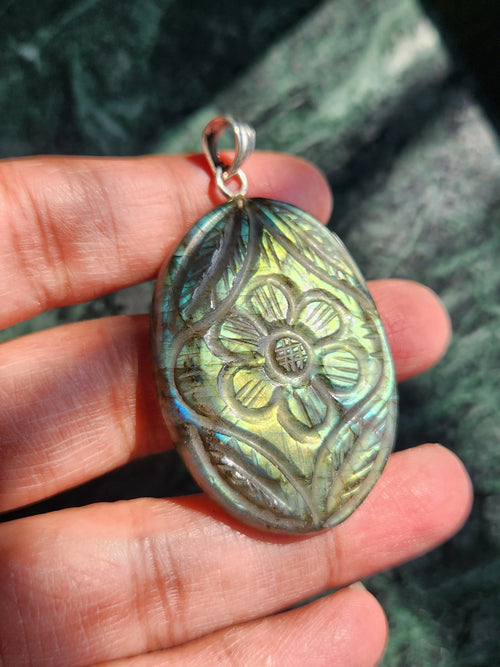
The Magic Of Labradorite Gemstone
This is exactly why many people find Labradorite so captivating.
You may buy one pendant because you love its blue flash, but after wearing it for some time, you may discover another colour that you had never noticed before.
One day it may look deep blue.
Another time, under a different light, you may notice green or golden flashes.
And when you move it just a little, the colour may disappear completely.
Then move it again and suddenly, the flash comes back.
That is the beauty of Labradorite.
It reminds us that sometimes the gemstone has not changed; our angle of viewing has changed.
So, the next time you look at your Labradorite and wonder why it appears different from yesterday, don't immediately think something has happened to your gemstone.
Look at the light.
Look at the angle.
Slowly rotate the stone.
You may discover a completely new flash waiting to reveal itself.
And perhaps that is one of the most beautiful things about Labradorite it doesn't show everything at once.
You have to move it to discover its colours.
If you have questions like these in your mind, feel free to ask us in the comments. A gemstone is a little piece of magic, but to experience that magic, you first need to clear your confusion and bring clarity within yourself.
The more you understand your gemstone, the more beautifully you can experience its uniqueness.